Vibrant Rainbow Mandala Stained Glass for Designers
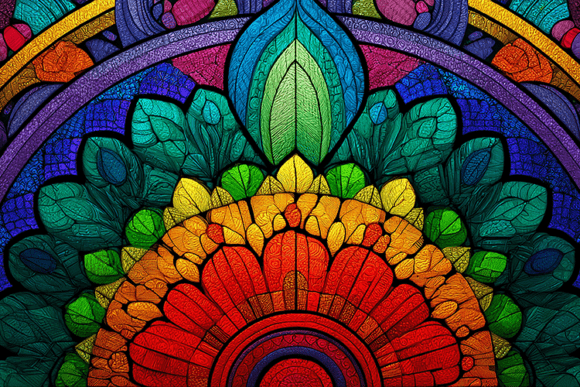
There is a specific kind of visual energy that happens when geometry meets color in its purest form. The Rainbow Mandala Stained Glass Art captures this perfectly, bridging the gap between ancient spiritual symbolism and the tangible, light-catching beauty of glasswork. For designers and creative entrepreneurs, this isn't just a pretty picture; it is a high-functioning design asset that brings an immediate sense of depth, symmetry, and vibrancy to any project. When you first look at this digital file, you see the intricate symmetrical details that define a traditional mandala, but the execution mimics the rich, multicolor texture of leaded glass.
This particular artwork stands out because it solves a common problem in digital design: finding imagery that feels both organic and structured. The "stained glass" effect provides a tactile quality that flat vector graphics often lack. The light seems to pass through the colors, creating a luminous effect that draws the eye inward. It is a style that feels premium and artisanal, making it an excellent choice for anyone looking to elevate their brand identity or creative projects with something that feels handcrafted yet digitally precise.
Understanding the Visual Power of Stained Glass Textures
In the world of design assets, texture is king. A standard digital illustration can sometimes feel sterile, but the Rainbow Mandala Stained Glass Art offers a tactile richness that changes how a viewer perceives the final product. The visual characteristics are defined by bold, black leading lines that separate blocks of saturated color. These lines create a natural grid structure that organizes the complexity of the mandala, making it easier for the eye to process despite the density of the design.
The personality of this artwork is bold, spiritual, and intricate. It carries a sense of history—referencing the rose windows of cathedrals or the intricate mosaics found in global architecture—but the rainbow color palette modernizes it. It feels relevant to current trends in boho-chic aesthetics, wellness branding, and psychedelic art revival. When used as a background or a focal point, it adds a layer of sophistication. It suggests that a brand values detail, craftsmanship, and vibrancy. For an entrepreneur or content creator, using this type of imagery signals a commitment to quality and visual storytelling.
Practical Applications: From Digital Screens to Physical Fabric
The utility of the Rainbow Mandala Stained Glass Art extends far beyond simple digital wallpapers. Because the file is provided as a high-resolution JPG at 6067 x 3400 pixels and 300 DPI, it is technically prepared for large-scale physical production. This makes it a versatile tool for a wide range of creative professionals.
Sublimation and Print-on-Demand
For those in the sublimation printing business, this design is a standout product. The 300 DPI resolution ensures that the intricate details remain sharp when heat-pressed onto substrates. Imagine this design wrapping around a ceramic mug, covering a throw pillow, or dominating a large yoga mat. The "stained glass" effect translates beautifully onto fabric and hard surfaces because the black lines provide a strong contrast that holds up well during the printing process. It turns an everyday object into a piece of art.
Editorial and Web Design
In editorial design or web backgrounds, this image serves as a powerful hero section background. However, because of its density, it requires careful handling regarding typography. When pairing fonts with this art, simplicity is your best friend. A clean sans serif font or a sturdy serif font in white or black will sit well on top of the multicolor texture without getting lost. Avoid using a script font or handwritten font for body text over this image, as the intricate background could make cursive letters illegible. Instead, use bold display fonts for headers to create a strong visual hierarchy.
Packaging and Branding
For packaging design, particularly in the wellness, tea, or artisanal food sectors, this mandala can be used as a wrapping paper pattern or a label background. It evokes feelings of balance and wholeness. When creating a brand identity around this art, the key is to let the mandala be the star. Use solid colors pulled from the mandala’s palette for your secondary brand elements to maintain consistency.
Strategic Design Pairings and Integration
Integrating a complex design asset like the Rainbow Mandala Stained Glass Art into a cohesive project requires a strategic approach. It is not enough to simply drop it into a file; you must consider how it interacts with your other design elements.
Color Extraction: The most professional way to use this art is to extract specific colors from the rainbow spectrum within the mandala to use elsewhere in your design. If the mandala features a deep royal blue and a vibrant magenta, use those exact hex codes for your buttons, headings, or accent graphics. This creates a unified look rather than a disjointed collage.
Opacity and Overlay: If the full-strength artwork is too overwhelming for a background, consider lowering the opacity to 20-30%. This creates a subtle, watercolor-like texture that adds interest without competing with your foreground text or products. Alternatively, use a duotone filter over the image to match a specific brand color scheme.
Scale and Cropping: Don't be afraid to zoom in. The symmetrical nature of the mandala means that a close-up crop of just one quadrant can create a stunning, abstract geometric pattern. This allows you to get multiple design variations from a single file, extending the value of the asset.
Technical Considerations for Print and Digital
When working with a file of this size and quality, technical execution matters. The dimensions of 6067 x 3400 pixels make this image landscape-oriented, which is ideal for desktop monitors, banner ads, and wide-format printing.
For digital use, such as social media graphics or website headers, you may need to optimize the file size for faster loading times without sacrificing the crispness of the "glass" edges. For print, the 300 DPI resolution is the industry standard for high-quality output. Whether you are creating printable wall art, scrapbooking elements, or large-scale wall murals, the pixel density is sufficient to prevent pixelation.
It is also worth noting the versatility of the JPG format. While it does not support transparency like PNG, its compatibility with virtually every software—from Adobe Photoshop and Illustrator to Canva and Procreate—makes it accessible for hobbyists and professionals alike. You can easily convert this to a pattern tile in Photoshop to create endless repeats for fabric design or digital paper packs.
Final Thoughts on Creative Utility
The Rainbow Mandala Stained Glass Art is more than just a decorative element; it is a versatile design system. Its strength lies in its ability to adapt to different contexts while maintaining its core visual impact. Whether you are a small business owner designing merchandise, a blogger looking for a unique header image, or a crafter creating personalized gifts, this artwork provides a solid foundation.
By understanding the interplay between the intricate geometry and the vibrant colors, you can leverage this asset to create projects that feel polished and intentional. It bridges the gap between the spiritual calm of the mandala and the structural beauty of stained glass, offering a unique aesthetic that is hard to replicate with standard stock photography. Use it wisely, pair it with clean typography, and let the colors do the heavy lifting for your visual storytelling.